Sonoff SNZB-02 Zigbee Temperature & Humidity Sensor
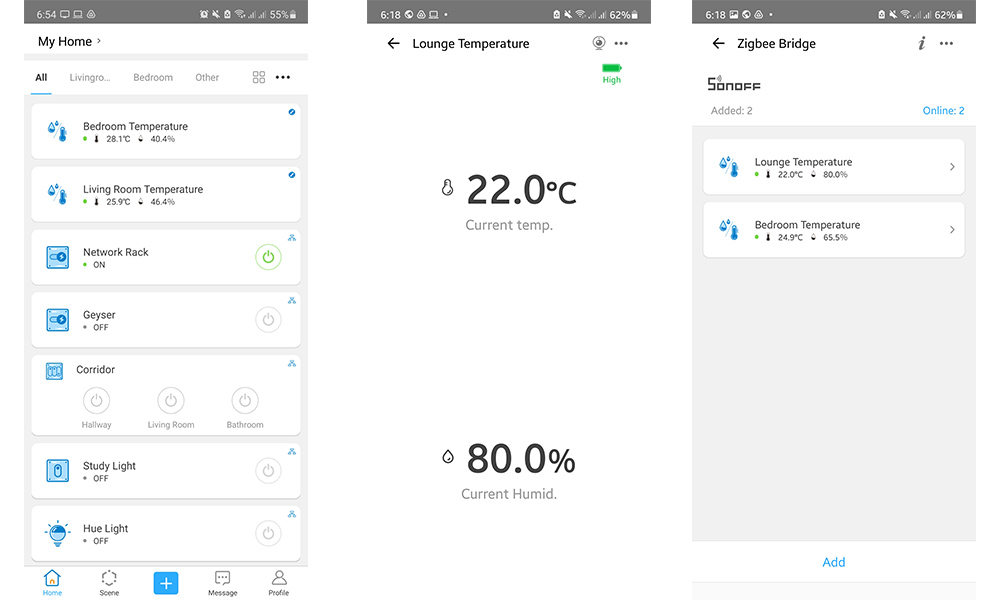
The Sonoff Temperature & Humidity sensor works exactly like advertised, but it has a big short coming that makes it difficult for me to recommend this sensor over it’s competitor from Shelly.
I bought this specific Sonoff sensor based on this marketing sentence from their website: “Measure the temperature and humidity in real-time, and sync data to your mobile phone in no time.” It turns out that “sync” functionality is very limited. There is no history synced.
That is the biggest drawback of the Sonoff SNZB-02, it does not record any history, the readings are real-time only which make this sensor kind of worthless to get any meaningful environmental data. Which means the only useful thing this sensor offers is the ability to turn on the fan if the temperature goes above a certain level.
Sonoff’s biggest competitor, Shelly, has a similar sensor called the Shelly H&T, which works directly on your Wi-Fi without the need for a Zigbee bridge and more importantly allows you to view the history of your temperature recordings in your home.
What are the PROS of the Sonoff SNZB-02 Zigbee Temperature & Humidity Sensor
- Lightweight & Small Footprint.
- Works with the EweLink App
- Long-lasting (about 1 year) and easy to replace button cell battery
- Accurate Measurements
- Ability to use it to control other connected Sonoff devices
What are the CONS of the Sonoff SNZB-02 Zigbee Temperature & Humidity Sensor
- Requires a Zigbee bridge in order to work, No Wi-Fi ability
- No History, you cannot see the history or a graph of your temperature readings
- False positives with the low battery warning (will often times say the battery is low even when it is not)
It’s still a fantastic device and works well despite these querks, but I genuinely hope Sonoff (ITEAD Intelligent Systems Co.Ltd.) will enable history readings in a future update. It will not be difficult to do, but I suspect their reasoning is budget related as it would require them to store the information on their servers, so it might become a paid feature.
Then again, if they do end up charging me to access my data then I will simply use Shelly instead.
Sonoff SNZB-02 Zigbee Temperature & Humidity Sensor Specifications
- Battery Model: CR2450 (3 volts)
- Dimentions: 43 x 43 x 14 MM
- Pairing Time: 30 seconds
- Supported Zigbee Gateways: Sonoff ZigBee 3.0 Bridge or any other bridge supporting the ZigBee 3.0 wireless protocol.
- ZigBee: IEEE 802.15.4
- Encryption Type: AES-128
- Working Temperature: -10 degrees to 40 degrees celsius
Popular Categories
Ad Blockers AWS Bitcoin CMD cPanel crypto Dark web Google IoT MikroTik Python Reviews SmartDNS Sonoff Tor VPN Windows WordPress Xiaomi Youtube Raspberry PiSubscribe (It's Free)
Featured Articles
Force all DNS traffic to go through Pi-hole using Mikrotik
The following mikrotik firewall rules will force all the clients on your local network like your Sony PlayStation and Google Chromecast to use your Pi-hole or your own local server as their primary DNS server, even if they have hard coded their own DNS servers we do this because many apps and devices do not use the offered DNS servers per DHCP, they are just that – an offer. Hardcoded DNS servers will still resolve and allow ads and tracking unless we use NAT rules that will redirect all DNS requests, no matter where they go, to the Pihole.
Read The Article
How to monitor the power usage of devices using a Sonoff Pow R2
Sonoff Pow R2 is a 16A WiFi smart light switch that allows you to remotely manage and control your appliances and monitor your home energy usage. The WiFi light switch works like a power monitor, which allows you to keep track of 99% accurate real-time current, voltage and power on your app.
Read The Article
A Beginner’s guide on how to browse the dark web with TOR
First thing to understand is that on the hidden web, you do not know about a website unless that website is shared with you. The dark web’s content on the internet isn’t accessible through traditional browsers or standard browsing technology. Content on the dark web is designed to be hidden from search engines and from casual users – you can’t simply stumble across dark web websites by accident.
Read The Article